
It is very unfortunate that China has decided to proceed with the controversial mega hydropower plants(despite the apparent opposition of many scientists in China). Why is Delhi silent about the development? asks Claude Arpi.
The Election Commission has extended the schedule for the Special Intensive Revision (SIR) of electoral rolls in Delhi, Punjab, Telangana, and Karnataka, along with Haryana and Andhra Pradesh. This revision involves house-to-house visits by Booth Level Officers and changes to draft and final roll publication dates, impacting the voter registration process across multiple states.

The monthly average rainfall over India is expected to be below normal during July, the India Meteorological Department said on Tuesday in its monthly forecast.
While tensions have eased at several friction points and mechanisms for managing the boundary have been reactivated, underlying differences persist. Disputes over naming practices in Arunachal Pradesh, continued infrastructure development on both sides, and unresolved questions regarding patrolling rights indicate that the structural gap remains, notes Dr Kumar.

India has strongly criticised China's practice of assigning 'fictitious names' to areas within Indian territory, stating that such actions are futile attempts to alter reality and negatively impact efforts to normalise bilateral relations.

India is home to more than 33 crore LPG users, yet consumption habits differ sharply from one region to the next. In metropolitan hubs such as Delhi, cooking gas is used far more frequently. In contrast, families in predominantly rural states like Bihar and Uttar Pradesh tend to make a cylinder last close to two months, as per PPAC estimates for 2025-26.

Above-normal cold wave days are expected in some areas of central India, eastern Uttar Pradesh and Bihar during January 2026.

'Nehru was an idealist, he was certainly a visionary in one way, but Mao Zedong was not. Mao Zedong was a very down-to-earth strategist. He wanted to take Tibet, to take the plateau, to take the rivers, to take the minerals.'

'It is flabbergasting to think that this heavenly region has, for decades, been coveted by India's aggressive neighbours,' says Claude Arpi after a recent visit to Ladakh. 'Wanting to use the newly created infrastructure to defend the borders after the clash of 2020 with China and the resulting standoffs, the home ministry is keen to boost border tourism to show that these areas are controlled by India.'
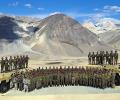
If China is accommodating regarding Depsang and Demchok, a resolution of the Sino-India territorial dispute in Eastern Ladakh could be possible.

Senior Superintendent of Police of Leh P D Nitya said the Army vehicle, with 10 personnel on board, was on its way to Nyoma from Leh when its driver lost control and it plunged into a gorge at 4.45 pm.

The India Meteorological Department (IMD) has predicted above-normal rainfall across India in June, with most parts of the country likely to experience normal to below-normal maximum temperatures. The IMD also anticipates above-normal minimum temperatures across most of the country, except for some parts of central India and the adjoining south peninsula. The southwest monsoon reached Kerala on May 24, marking its earliest arrival over the Indian mainland since 2009. The monsoon is crucial for India's agriculture-dependent economy, providing vital water for crops and supporting drinking water and hydropower generation.
India on Wednesday outright rejected China's attempts to rename some places in Arunachal Pradesh, saying such 'preposterous' attempts will not alter the 'undeniable' reality that the state 'was, is, and will' always remain an integral part of India.

With the two armies again in a face-off at multiple points, there is apprehension of renewed clashes.

The next Census' findings will help identify the extent of India's ageing population and vulnerability levels.
The eastern Ladakh military standoff between India and China began in May 2020 and a deadly clash at the Galwan Valley in June that year resulted in a severe strain in ties between the two neighbours.

India recently outflanked China by taking control of strategic height near Pangong lake's southern bank.

The Indian Army has occupied several key heights in the strategically located Rezang-La and Reqin-La areas on the southern bank of the lake since the end of August.
For both India and China, the most likely option -- and the most challenging -- appears to be a freezing of the status quo.

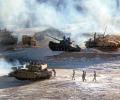
The Indian Army started bringing the T-90 Bhishma and T-72 Ajay tanks along with the BMP series Infantry Combat Vehicles from the deserts and plains in a big way to these high altitude locations from last year with the beginning of the Operation Snow Leopard to counter the Chinese aggression in eastern Ladakh last summer.
On the first day of his two-day visit to Ladakh, Gen Naravane held a series of meetings with top commanders about the evolving situation in the region as well as on India's overall combat readiness to deal with any eventualities, military sources said.
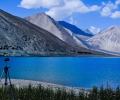
The capture of the Chinese soldier comes in the midst of an eight-month-long bitter border standoff between the two armies in eastern Ladakh.
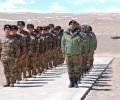
There was no comment from the Indian side on the statement made by the Chinese defence ministry spokesperson Colonel Wu Qian, and carried by China's official media.
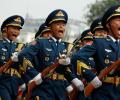
Since the June 15 clash, the PLA has inducted large numbers of troops, armoured vehicles and artillery along the LAC, from Depsang and Galwan in northern Ladakh to Hot Springs, Pangong Tso, and Chushul in central Ladakh, to Demchok and Chumar in southern Ladakh.

The sources said the situation in eastern Ladakh remained 'tense' and that around 30-40 soldiers of China's People's Liberation Army (PLA) are holding up at a position close to an Indian post in the Rezang-La ridgeline in eastern Ladakh.

External Affairs Ministry Spokesperson Anurag Srivastava said India is committed to resolve all issues through dialogue, noting the way ahead to address the issue is negotiations.
The sources said both sides held extensive deliberations on modalities for disengagement of troops from all the friction points in eastern Ladakh at the talks.
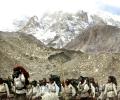
The Indian Army will continue to maintain its aggressive posturing in all disputed areas in eastern Ladakh and will not back off till status quo is maintained, sources said.
The commanders will also deliberate on the overall situation in Jammu and Kashmir besides delving into issues having national security implications, they said. However, the main focus will be on the situation in eastern Ladakh where Indian and Chinese troops are locked in an eyeball-to-eyeball face-off in Pangong Tso, Galwan Valley, Demchok and Daulat Beg Oldie, the sources said.
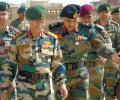
The main focus will be on the situation in eastern Ladakh where Indian and Chinese troops are locked in an eyeball-to-eyeball face-off in sensitive areas like Pangong Tso, Galwan Valley, Demchok and Daulat Beg Oldie

Out of 18, four personnel were critically injured but they are responding to treatment and are stable now, people familiar with the matter said.

The talks between India and China on the border row in eastern Ladakh have helped 'build trust' and the situation in the region has been normal since the disengagement in the Pangong Tso areas in February, Chief of Army Staff General M M Naravane said on Thursday, exuding confidence of resolution of the 'remaining issues'.

Defence Minister Rajnath Singh on Saturday asserted that the government will not allow India's pride to be hurt under any circumstances even as he said bilateral talks were on at military and diplomatic levels to resolve the row.
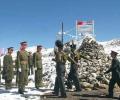
People familiar with the situation in the region said the two sides were engaged in trying to resolve the dispute, but there was no indication of a positive outcome yet as both the armies continued to bolster their positions in disputed areas of Pangong Tso and Galwan Valley and Demchok.

The IMD said that rainfall over India in August and September would be around 106 percent of the long-period average of 422.8 mm.

General Zhao Zongqi is well known in India for having commanded the Chinese troops during the Dokalam episode. Zhao knows every inch and corner of the Indian border, at least the Eastern and Central sectors, including the Naku La area which witnessed fist-fights between Indian and Chinese troops in April/May. Claude Arpi introduces us to the PLA generals masterminding the Chinese aggression in Ladakh.
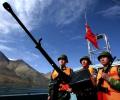
The Chinese side has particularly bolstered its presence in the Galwan Valley, erecting around 100 tents in the last two weeks and bringing in heavy equipment for construction of bunkers, notwithstanding the stiff protest by Indian troops. There have been reports of multiple incidents of transgressions by Chinese troops in several areas in Eastern Ladakh.

Asked about the reports of the troops on both sides disengaging and moving back to their previous positions, Chinese foreign ministry spokesperson Hua Chunying told a media briefing in Beijing that both sides are taking steps to ease the situation along the borders.
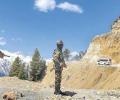
China and India have agreed to work to maintain peace along the Line of Actual Control and resolve the border standoff through talks while implementing the consensus reached between the two countries' leadership that 'differences' do not escalate into 'disputes', a top Chinese official said.
India on Thursday once again called for completion of the disengagement process at the remaining friction points in eastern Ladakh to pave the way for both the Indian and Chinese troops to consider de-escalation and ensure full restoration of peace and tranquillity in border areas.
